I've watched this movie too many times. A decade of enterprise transformation and the same reel keeps playing. A proof of concept dazzles. A pilot generates real momentum. Leadership claps. And then nothing scales. The initiative quietly gets a new sponsor, a new name, a slower budget — and eighteen months later, no one can point to what actually changed. The transformation dies quietly in the change log.
Meanwhile, a competitor ran the same play — at ten times the scale — and pulled ahead for good.
My own version of the scar: the demo got applause, the real kind that makes a room lean in. Eighteen months later I killed the product. It worked. It was well built. And almost nobody used it, and it moved nothing the business was actually measured on. I had shipped a capability and mistaken it for a result. That mistake took me a decade to fully understand. Now I hear the same story every week — at conferences, on podcasts, in peer conversations across industries — enterprises making the same mistake at a hundred times the cost, with AI. It was never a technology mistake. It was a scaling mistake. An operating-model mistake.
Here is the whole idea in a sentence: most organizations don't struggle to build AI. They struggle to make it matter. Every capability that ever created real value moved through five stages — and the fifth is the one almost nobody reaches.
This work builds directly on my earlier framework, The New 4Ps of AI Product Transformation (LinkedIn, 2025) — POC → Pilot → Product → Platform. Reading a stack of 2026 strategy research from the top firms, the four kept pointing to a fifth stage none of them named. That stage is Performance. If you haven't read the 4Ps piece yet, start there — this article is what comes next.
The 5Ps assumes your commercial technology stack is sequenced correctly. If it isn't — if identity is unmastered, governance is reactive, or foundational workflows are missing — even a perfectly executed 5Ps will stall at Platform. That sequencing question at the stack level is what the B·E·A·T Framework answers. B·E·A·T sequences the enterprise. The 5Ps sequences the AI capability. Together they answer both sequencing questions any transformation leader faces at once. If you're not sure whether your stack is ready for the 5Ps, take the Advanced B·E·A·T Decision Engine first — it maps your posture and tells you which 5Ps stages are safe to pursue given where you actually are.
Why this transformation is different — and why the sequence matters more now than ever before
The technology is compounding, not just improving — and every prior transformation playbook was written for a world where it didn't.
Rate change, not step change
Digital, cloud, mobile were step changes. You adopted the technology, the org absorbed it, the curve flattened, laggards caught up. AI is not doing that. Every model generation, every cycle of usage makes the next capability faster and cheaper. The frontier moves while you chase it.
The org chart is the product
In every prior wave, technology was fitted into an existing operating model. This one is different. The operating model is the deliverable. Leaders aren't launching AI features. They're rewriting their org charts around AI-native structures.
The window is short and asymmetric
Prior transformations gave you years to sequence right. AI capability is not plateauing. Every quarter you delay Platform → Performance, the compounding gap widens and the cost of catching up multiplies. Sequence matters more now than in any prior wave.
The prize is a leaner, AI-native enterprise
Not more AI. A next-generation organization — smaller, faster, higher-leverage. Intelligent systems handle orchestration and routing. Humans own judgment and outcomes. The whole shape is designed for compounding value.
Sources for the receipts above Show 9 referencesHide references
- Meta — Superintelligence Labs, CAO, four-team restructure. Axios (Oct 2025); TechCrunch (Oct 2025); Built In.
- Microsoft — CoreAI (Platform & Tools). Microsoft Official Blog — Satya Nadella (Jan 13, 2025).
- Google — DeepMind and product surface reorganization. Public restructuring announcements across 2024–2025 aligning research and applied AI under unified leadership, covered by major technology press.
- Amazon — retail, ops, and AWS rewired around agentic workflows. Ongoing public commentary from Amazon leadership through 2025–2026 on agentic AI integration across retail, operations, and AWS product launches.
- Salesforce — Agentforce platform reorganization. Salesforce News — Dreamforce 2024 recap.
- JPMorgan Chase — AI Accelerator, ~2,000 AI/ML specialists, Dimon on hiring more AI, fewer bankers. Bloomberg (May 2026); Fast Company (May 2026); eFinancialCareers on the JPMorgan AI Accelerator.
- Moderna — HR + IT merged into People & Digital, 3,000+ custom GPTs. Forbes (Aug 2025); OpenAI — Moderna case study; Constellation Research on the 750 GPTs in the first two months.
- Walmart — merchandising and supply chain around AI decisioning. Supply Chain World — Walmart AI-driven supply chain expansion (2025); Food & Drink Digital on Walmart's four AI super agents.
- Goldman Sachs — headcount constraint as AI absorbs knowledge work. Public commentary from CEO David Solomon and Q3 2025 earnings coverage; industry reporting on Wall Street banks constraining hiring during a strong revenue year.
Every downstream section — pilot paralysis, the mindset shift from Product to Platform to Performance, the flywheel, the scorecard — only lands if you accept the underlying claim: this is not a transformation you can defer, do partially, or copy from a competitor's playbook. It's a transformation where sequence beats spend, mindset beats maturity, and Performance is the only stage that produces a next-generation enterprise. That's why the 5Ps exist. Everything after this is the how.
The real problem isn't the model. It's pilot paralysis.
As economic pressure intensifies, every AI investment now has to prove measurable business value. Most can't. They're stuck in pilot paralysis — a portfolio of isolated experiments that impress in a demo and never scale.
The instinct is to blame the technology. It's almost never the technology. The models work. What's missing is the operating model around them — governance, data foundations, ownership, and an honest ROI framework that ties each use case to a strategic business outcome instead of a vanity metric. Pilot paralysis doesn't end when you buy a better model. It ends when you stop measuring activity and start measuring advantage.
Why enterprises keep failing to scale AI — and why the 5Ps mindset matters more than the frame
Every failed AI program fails for one of five reasons. It's never the model.
Change the technology and the same program fails again in twelve months, wearing a new name. It's an operating-model failure, not a tech one.
When teams look for a mental model, they reach for the one they know: People, Process, Technology. It's the right level. But PPT is a static X-ray — it names the ingredients. It's silent on the sequence that turns them into value.
People · Process · Technology
- Names the ingredients you have
- A static snapshot of the org
- Answers: "what are we made of?"
- Silent on sequence, reuse, velocity, outcomes
- Can be all-green while nothing scales
The 5Ps mindset
- Names how far you've actually gotten
- A sequence from experiment to advantage
- Answers: "what's the next move — and in what order?"
- Built on reusability, velocity, performance
- Forces the question of leverage and durability
Product → Platform → Performance is the mindset shift
The heart of the 5Ps. Three mindsets, run as one. This is what separates enterprises that scale AI from enterprises that ship demos.
Ship reliability, not novelty.
A capability isn't real until it has an owner, an SLA, monitoring, a retraining cadence, and a support path.
If the original data scientist leaves and it dies, you never had a product. This is where scaling discipline begins — and where most enterprise AI quietly dies without anyone noticing.
Leverage over rebuild.
The next capability starts at 60%, not zero. Identity, data, governance, feedback loops become shared services.
This kills fragmentation. Velocity stops being heroic and becomes structural. If governance is being reinvented per project, you don't have a platform — you have agents.
Results over activity.
Every capability is tied to a specific P&L outcome. Every leadership review asks how much further ahead the AI is putting you — not whether it's live.
This is where the flywheel starts. It's the mindset that changes the review meeting, the funding cycle, and eventually the org chart.
Read the three mindsets together and you have the definition:
Enterprises audit PPT, declare readiness, and skip the sequencing question. Then they wonder why a well-staffed, well-funded, well-technologied AI program still produces isolated pilots. The answer isn't more people, better process, or newer tech. It's a mindset that carries a capability through all five stages until it compounds. That mindset is the 5Ps — and it answers the question PPT never asks: how do we actually turn all of this into compounding advantage? The rest of this article is what it looks like in practice.
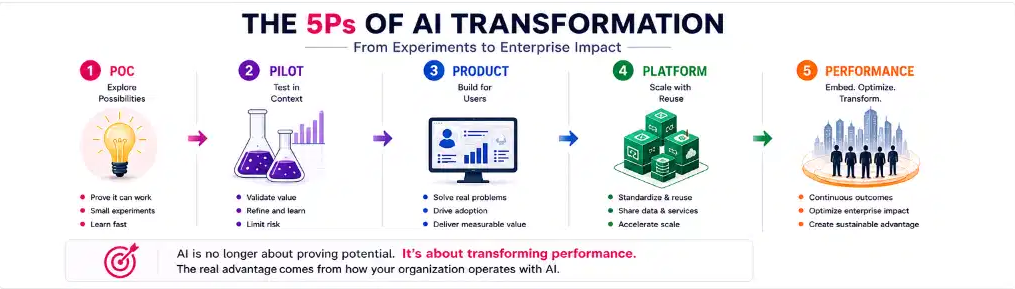
The five Ps, honed
Each P answers exactly one question. Skip the question and it comes back later, more expensive, wearing a different name. To make it concrete, follow one capability the whole way — an AI system that recommends the next best action for a customer-facing team.
Can it work at all?
A data scientist shows the model would have beaten the status quo on a clean slice of history. It ran once, on curated data, for one segment.
Cheap, fast, seductive — and its entire limit is that it has proven possibility and nothing else. Applause here is not a mandate to scale. It's permission to run a pilot.
Prove it worksDoes it work in the wild?
A few teams use the recommendations live for ninety days. The mess shows up — stale records, missing consent, a recommendation the frontline can't act on. Half the magic evaporates.
Good. Better to learn it here than in a board update. The trap is declaring victory on high usage when the foundation underneath was never ready.
Prove it in the wildCan anyone use it, repeatedly?
It gets an owner, an SLA, monitoring, a retraining cadence, a support path. Someone who never met the original data scientist can run it, trust it, and escalate when it breaks.
This is where most AI quietly dies — not in failure, but as a working thing only its creators can operate. Product is where scaling discipline begins.
Make it repeatableCan others build on it?
The identity resolution, the feedback loop, the governance and audit trail get pulled into shared services. The next capability doesn't start from zero — it plugs in.
Platform is where reusability and velocity compound, and where fragmented, siloed adoption gets solved by one governed foundation instead of a hundred disconnected agents. The trap is mistaking the platform for the destination. You've built the machine. You haven't yet proven it prints money.
Make it reusableIs it creating value every day — value that compounds?
The recommendations now measurably move the numbers the business runs on — and the advantage grows, because every action feeds the loop that makes the next recommendation sharper.
This is the only stage where the moat is yours and not the vendor's. It's also the stage most organizations never actually reach.
Make it compoundThe first four are becoming commodities. Every enterprise can reach frontier models; every vendor ships copilots; every firm sells agents. Harvard Business Review named the endgame — the agentic convergence trap: when everyone buys the same models and deploys the same agents, everyone ends up looking the same. Every major technology era has bent this way — the digital era, the cloud era, the data era. Initial differentiators, then eventual table stakes. The agentic era will not be the exception. So POC, Pilot, Product, and Platform are the price of entry — necessary, not sufficient. This is exactly what I keep hearing across conferences, podcasts, and peer conversations — the same pattern that played out a decade ago in digital transformation, only this time at a hundred times the cost, with AI. It was never a technology mistake. It was a scaling mistake. An operating-model mistake.
"AI is becoming a utility. Execution is not."
What is an AI-native enterprise?
Before the operating model, the definition — because the phrase gets used carelessly. An AI-native enterprise is not a company that uses AI. Every company uses AI now.
"An AI-native enterprise is one whose operating model assumes AI. Take the AI away and the organization stops working — not slows down, stops."
That's the test. In an AI-native enterprise, intelligent systems are load-bearing: they handle orchestration, routing, and repeatable decisions at scale, while humans own judgment, relationships, and outcomes. Work is designed around human-agent teams from the start. Governance, data foundations, and outcome measurement are wired into the rails, not bolted on afterward. New capabilities plug into a shared platform and start close to production, not close to a POC.
The opposite is a company that has AI inside it — copilots here, agents there, a chatbot somewhere — but whose org chart, funding model, and decision rights would look identical if you switched it all off. That's an AI-using enterprise. It looks modern in the demo. It scales like it's 2015.
Reaching Performance is what takes you from AI-using to AI-native. Not another platform launch. Not another agent. The reason "Performance" is worth the name is that it's the first stage where the organization itself — roles, incentives, decisions — has actually changed to assume AI. The 5Ps are the path from one to the other.
The 5Ps are the operating model of an AI-native enterprise
Here's the part most frameworks miss. The 5Ps aren't just a maturity ladder. Run end to end, they are the operating model — and the operating model is the whole game.
- POC and Pilot are how you prove. They exist to generate evidence and kill bad bets cheaply. Their output isn't value — it's learning. Treat them as disposable, not as milestones to celebrate.
- Product and Platform are how you scale. This is where the operating model gets built: ownership and accountability, then reusable services, shared data and technology foundations, and governance-as-code. This is how you move successful pilots into production by building the right governance and operating model, and how you reduce fragmented AI adoption through stronger data and technology foundations — one governed platform instead of a hundred one-off agents.
- Performance is how you win. Every capability is aligned to a strategic business outcome and measured against it — this is how you achieve measurable AI ROI by aligning use cases with strategic business outcomes. The organization is rewired so intelligent systems handle orchestration and routing while humans own judgment, relationships, and outcomes.
Put the whole arc together and you have the definition of AI-native. Not a company that uses AI. A company whose operating model assumes it. That's the mindset shift: reusability over rebuilds, velocity over one-off wins, performance over activity.
The fifth P: Performance — the last moat
Performance is where AI stops being a project, a capability, or a platform — and becomes part of how the business creates value on an ordinary Tuesday. Here's the distinction almost everyone gets wrong:
"Platform is a capability. Performance is a result."
Platform
- Shared services and reusable components exist
- Governance and orchestration are in place
- Teams can build on common infrastructure
- Measured in coverage, adoption, reuse
- Answers: "Can we build AI at scale?"
Performance
- Specific business metrics move — and keep moving
- The advantage compounds quarter over quarter
- Competitors can't replicate the outcome
- Measured in margin, cycle time, growth, retention
- Answers: "Is AI widening our lead?"
A platform can be copied. A result compounds — and it's why Performance is the last moat. Two companies buy the identical model; one gets a chatbot, the other rewrites its unit economics. The model was never the variable. The operating model was.
Performance · 01What Performance actually measures
"Performance" is not a vibe. If you can't put a number on it, you're still at Platform. It reduces to three tests — and you need all three, not one.
A number the business runs on moved
Pick the metric your function is actually judged on — not usage, not adoption.
- Revenue, margin, cost-to-serve
- Cycle time, time-to-decision
- Conversion / win rate
- Retention / churn, quality / error rate
It's still improving — and accelerating
A one-time bump is a project. Performance keeps bending the curve.
- Metric improves quarter over quarter
- Unit cost per AI decision is falling
- Reuse rate is rising
- Time-to-launch for the next use case drops
A competitor couldn't copy it
The advantage is tied to what only you have, not to the model.
- Rooted in proprietary data & workflows
- Embedded in your decisions & relationships
- Survives a rival licensing the same model
- Grows with every cycle you run
Put together, that's a Performance scorecard: an outcome that moved, is still moving, and can't be bought. Anything short of all three is a capability wearing a result's clothes.
The Performance Scorecard — three lenses, nine metrics
The three tests above translate into a scorecard leadership can actually read at the board level. Every metric belongs to one of three lenses. Miss a lens and the story is incomplete — and incomplete stories are the ones that get killed in the next budget cycle.
Investment Leverage
Are we getting more out of every dollar and every hire?Return Multiplier
Answers "is this actually paying back?" — the single number a CFO will look at first. Below 1× you're subsidizing hype; above 2× you have a program.
Leverage Ratio
Are outcomes outrunning cost? Ratios above 3× are the signature of a program that's compounding rather than adding.
Cost-Line Bend
The check leadership actually asks: is the total cost line bending down in absolute terms — not just as a ratio? Ratios can improve while spend explodes.
Operating Scale
Is the enterprise moving faster and reusing more each cycle?Idea-to-Live Cadence
How fast can the org actually ship? Cadence improving means the operating model is working. Flat cadence is a Product-stage tell.
Portfolio Penetration
Depth beats breadth. A high number here means AI isn't a side project — it's inside how the business actually runs.
Platform Reuse
The single best proxy for whether Platform is real. Low reuse means every team is rebuilding — you have agents, not a platform.
Trust & Durability
Is it actually good, actually used, and actually ours?Decision Confidence
The credibility question. High confidence means the AI is trusted enough to be acted on. Low confidence quietly kills adoption regardless of the ROI slide.
Live Stickiness
The shelf-life test. High shipping volume with low stickiness means you're producing software nobody uses. Real Performance survives day 90.
Compounding Signal
Is the flywheel actually turning? If output per unit of input is rising each quarter, compounding is real. If flat, you've built a Product, not a flywheel.
How to read it. Three lenses, nine metrics — you need honest movement across all three. Investment Leverage alone tells you the ratio is improving, but the cost line can still be climbing. Operating Scale alone tells you the org is producing, not that anyone is using. Trust & Durability alone tells you it's good, not that it scales. The Rav Scorecard forces the honest question: are we creating leverage, at scale, at a quality customers and regulators would defend? All three, or it's not Performance.
What to instrument first. If you're building this scorecard for the first time, start with C1, C2, and A3 — the ones most enterprises don't already track. Everything else is variations on numbers you likely have. Trust and cost trajectory are the metrics that separate a real Performance story from a compelling one.
Performance · 02 — Why Performance becomes a flywheel
The first four Ps add. The fifth compounds. Once a capability reaches Performance, its own output becomes the fuel for the next turn — and the wheel spins faster on its own.
- More usage & proprietary data. Every action the AI takes generates outcome data no competitor has.
- Sharper decisions. That data trains better models and tunes the workflow — recommendations get more accurate.
- Better outcomes. The business metric moves, trust rises, and adoption widens — which drives more usage. The loop closes.
- The wheel accelerates. Meanwhile the platform makes each new capability cheaper and faster to launch, so more capabilities enter the loop. Advantage stops being additive and starts compounding.
Performance · 03How Performance rewires the operating model
You can't run a flywheel with a project mindset. Reaching Performance forces four changes to how the organization actually operates — this is the "transformation" part everyone skips.
- Funding shifts from projects to outcomes. You stop funding POCs and start funding standing product teams accountable for a P&L metric. Budgets follow the number, not the roadmap.
- Decision rights get explicit. You define what agents decide autonomously, what needs a human, and where the escalation lines sit — before you scale, not after an incident.
- Roles are redrawn around human-agent teams. Agents handle orchestration and routing; humans own judgment, relationships, and outcomes. New roles appear — AI product owner, agent operations, governance lead.
- Governance becomes the accelerator. Embedded audit trails and a measurement framework tied to the P&L let you scale safely and fast. The review question changes from "is it live?" to "how much further ahead are we?"
Performance · 04How to actually move: the playbook
Frameworks are only useful if they tell you what to do on Monday. Here's the practical move at each transition — the ones where companies actually get stuck.
Stop starting. Freeze new POCs. Pick one or two pilots that map to a named business metric, give each a real owner, and build the one missing foundation (usually identity or data) once. Set a production gate tied to data quality, not the launch calendar.
Extract the reusable core. Pull identity resolution, the feedback loop, and governance out of your one working capability into shared services. Success test: the next team starts at 60%, not zero — and doesn't rebuild governance.
Attach every capability to a P&L metric and close the loop. Instrument outcomes back into the model, shift funding to outcome-owning teams, and change the leadership review question. This is the step that starts the flywheel.
Feed the wheel. Reinvest the compounding gains into more capabilities on the same platform, widen the data moat, and guard the loop — a broken feedback signal quietly stalls the flywheel long before the metric shows it.
The Performance Test
- Can you name the business metric your AI moved last quarter — and by how much? Not usage. Not adoption. Margin, cycle time, growth, retention.
- Is that number still moving — or did it plateau the month after launch?
- If a competitor licensed your exact model tomorrow, what would they still not have? If the answer is "nothing," you don't have a moat. You have a subscription.
- Does your AI get sharper every time it's used — or does it just run?
- In your last leadership review, was the question "is it live?" — or "how much further ahead are we?"
Two tools, one question
The Performance Test above tells you which P you're in. The B·E·A·T Decision Tool tells you what to build next, and in what order. Use them together.
The Performance Test
A quick self-check on where you sit across the 5Ps and whether you're actually compounding. No inputs, no tool — just five honest questions.
↑ Just aboveScore your organization
The deeper diagnostic: six dimensions map your sequence, your primary risk, and your AI-readiness signal — with a specific recommendation for the next move.
Score your organization with B·E·A·T →The evidence, briefly
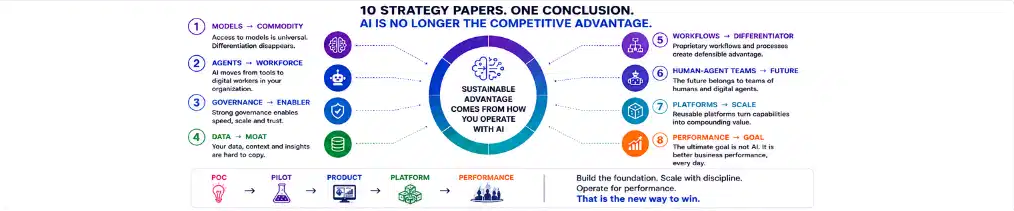
I didn't arrive here alone. Reading a stack of 2026 strategy research side by side — McKinsey, Bain, Deloitte, IBM, PwC, BCG, Harvard Business Review — the language differed but the conclusion didn't: the AI race is no longer about models. It's about operating models. Models commoditize; workflows, data, and governance don't. Pilots don't create value; production does. Agents execute; humans own the outcomes. The winners build platforms, not agent sprawl — and then push past platforms to Performance.
If you want to lead this
Stop counting POCs. Stop celebrating platforms. Start defending outcomes. The companies that understand this early won't just build AI systems — they'll build new ways of operating, and those operating models will be the most defensible advantage of the agentic era, precisely because they're the one thing a competitor cannot purchase.
For the first time in decades, technology is no longer the hard part. Redesigning the organization around it is. Everything before Performance is just getting ready. So be honest about which P you're actually in — then go earn the fifth.
"AI is not your advantage. Performance is — and it's the one P you can't download."
Related essays
The 5Ps sits inside a larger body of practitioner writing. Each of these deepens a specific piece of the argument — the origin framework, the sequencing question, the human side of AI adoption, and the durability of first principles.
The New 4Ps of AI Product Transformation
The B·E·A·T Sequencing Framework for Pharma Commercial
The Pharma Commercial Technology Sequencing Problem
Everyone's Running to Catch the AI Train. Who's Driving the Bus?
Tools Keep Changing. What I Learned in My First Job Hasn't.
The B·E·A·T Framework & Decision Tool
Find out which P you're actually in
Take the Performance Test above, then go deeper: the B·E·A·T Decision Tool scores your organization across six dimensions and maps your next move — in about two minutes. No forms.
References — the ten strategy papers (April–May 2026)
- PwC — 2026 AI Performance / Predictions Study.
- McKinsey & Company — From AI Table Stakes to AI Advantage.
- Harvard Business Review — Beware the Agentic Convergence Trap.
- IBM — Rewiring the C-Suite / 2026 CEO Study.
- BCG — AI Has Made Work Reinvention a CEO Mandate.
- Harvard Business Review — Why You Shouldn't Treat AI Agents Like Employees.
- Bain & Company — AI's Next Operating Model.
- Deloitte — Rethinking Operating Models for Humans with Agents.
- IBM — The Blueprint for Agentic Operations.
- McKinsey & Company — Building the Foundations for Agentic AI at Scale.
The 5Ps is original practitioner work, extending the New 4Ps of AI Product Transformation. Citations above reflect the industry pattern the framework describes — not endorsement by the firms named.
More 5Ps deep-dives publishing on LinkedIn & Medium. This page is the canonical home.